

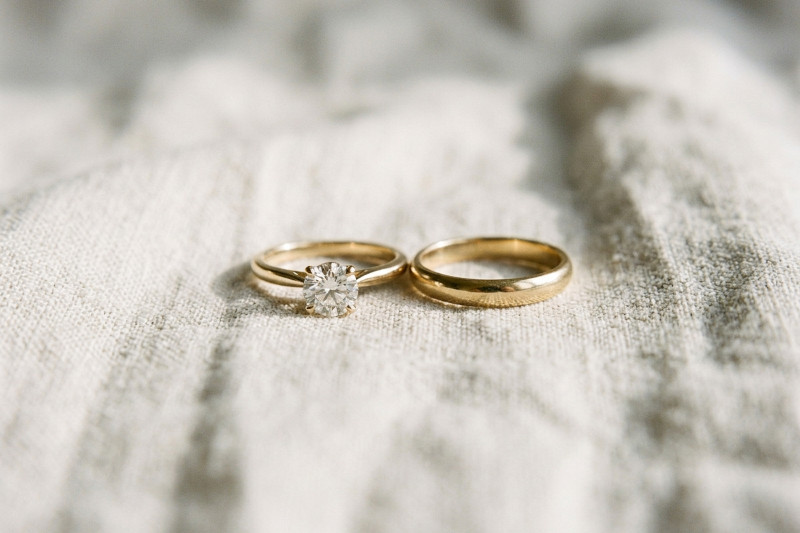
A wedding ring set is an engagement ring and a wedding band designed to be worn together, usually bought at the same time. The appeal is simple: the two rings match, they sit properly side by side, and you only have to make the big decisions once.
Buying them together isn't automatically the right call, though. Whether a set suits you depends on the engagement ring you like, the metal, how the rings are set and what you'll want from them in ten years.
What a wedding ring set is
The term covers a few different things, so it's worth being clear about what you're looking at in a shop.
Usually it means a bridal set: an engagement ring and a wedding band made as a pair, in the same metal and finish, often with matching stones. The band may be straight, or it may be shaped to follow the outline of the engagement ring. The GIA's guide to ring settings shows a typical example, a channel-set engagement ring with a matching channel-set wedding band.
You'll also see the phrase used for matching wedding bands for both partners, or for an engagement ring plus two bands. All of them come down to the same question: do you want the rings chosen together, or chosen separately?
Why couples buy the rings together
The strongest argument is fit. An engagement ring with a raised centre stone or a wide head doesn't always sit flush against a plain band. Buying the two together means you can see them on your finger as a pair before you pay, instead of finding a gap or a clash months later.
Matching the metal is the second reason, and it matters more than people expect. We cover how metals age in detail below, but two rings in slightly different alloys can start to look different over time, even if they matched in the shop.
And there's the practical side. You choose the style once, the rings are sized together, and you're not trying to remember the exact shade of your engagement ring while standing at a counter a year later.
When buying separately makes more sense
Plenty of people still buy the band later, and there are good reasons to.
Some engagement rings are easy to pair. The GIA notes that solitaire styles, a single stone with little else around it, go with a wide range of wedding bands. If that's your engagement ring, you lose very little by waiting.
Budget is another reason. Spreading the cost over two purchases is easier for a lot of couples, and some prefer to put more into the engagement ring now and choose the band closer to the wedding.
Taste can also change. Some people want a band that contrasts with the engagement ring, such as a plain gold band next to a diamond ring, or a different metal altogether. If you'd rather choose the band once you've worn the engagement ring for a while, there's no rule that says you have to buy both at the same time. Our guide on choosing a wedding ring to match your engagement ring covers that route.
Straight bands and shaped bands
The shape of the engagement ring decides a lot. The GIA describes the cathedral style, where arches of metal lift the centre stone high above the band. It looks dramatic, but a raised head can leave a gap above a straight wedding band, and the GIA notes that a raised setting is also more likely to catch on clothing.
A shaped or fitted band follows the outline of the engagement ring so the two sit together without a gap. That's often where a set earns its keep, because the band is made with that particular engagement ring in mind. We go into this in our guide to shaped wedding rings.
The trade-off is that a shaped band is tied to its engagement ring. If you change the engagement ring later, the band may not suit the new one. A straight band is more flexible.
Why the metal has to match properly
Two rings worn side by side every day rub against each other and age together, so the metal is the one thing worth getting exactly right.
White gold is a good example. According to the GIA, white gold is gold alloyed with metals such as silver or palladium, copper and zinc, and it's usually plated with rhodium for a bright white finish. That plating wears away gradually, and the ring needs replating from time to time. The GIA also points out that because of the plating, 14 carat and 18 carat white gold can be hard to tell apart by eye. The quality mark inside the ring tells you which you have.
That's why a set should be the same metal at the same fineness, rather than two rings that merely look the same colour. A white gold engagement ring next to a white gold band of a different carat, or next to a platinum band, can look very similar on day one and quite different a few years in.
Platinum and palladium behave differently from gold. The GIA describes platinum as denser and stronger than gold, and palladium as strong, lighter, hypoallergenic and resistant to tarnish. Platinum alloys used in jewellery are usually 90 to 95 percent pure, compared with 58.5 percent for 14 carat gold and 75 percent for 18 carat, so the same ring weighs more in platinum. If you're mixing metals deliberately, try the combination on and ask how each one will wear. There's a fuller comparison in our article on wedding ring metals.
Check the hallmark on both rings
In Ireland, every article of gold, silver, platinum and palladium has to be assayed and hallmarked, and the Assay Office of Ireland confirms there are no exemptions by weight. That means each ring in a set should carry its own hallmark, however slim the band.
The compulsory marks are the sponsor's mark, which identifies who is responsible for the piece, Hibernia, the mark of the Dublin Assay Office, and the fineness mark, which gives the metal content in parts per thousand. On gold, 375 is 9 carat and 750 is 18 carat. If a set is sold as matching, the fineness marks on the two rings should match too.
Think about settings and resizing before you commit
If both rings in a set have stones, the way those stones are held affects how the rings wear and whether they can be altered later.
Channel settings, where stones sit in a groove between two walls of metal, are durable and well suited to everyday wear but sometimes sizing channel set rings is a little more tricky. Pavé, where small stones are set close together across the surface, needs occasional maintenance and can collect more dirt. Halo designs, with many small stones around the centre, may also need a little more upkeep.
Resizing is where sets can catch people out. The GIA says channel, bar and pavé bands can be harder to resize, especially if the stones run a long way around the ring, and tension-set rings can be very difficult or even impossible to resize. Ask about resizing before you buy. Our ring resizing page explains what the job involves.
All rings will also need some care over the years. The GIA notes that prongs after years of wear may need re-tipping and that metal surfaces benefit from occasional polishing or recoating. With a set, it makes sense to have both rings checked at the same time.
Setting a budget for two rings
It's easy to spend the whole budget on the engagement ring and leave the band as an afterthought. With a set, you're pricing both at once, which can make the total clearer from the start. If you're working out figures, our guide to how much wedding rings cost in Ireland is a useful companion.
If you're buying bands for both partners as well, read our guides to women's wedding rings and men's wedding rings. Matching the second band to the metal of the bridal set is a choice, not a rule.
Try them on together
Whether you buy as a set or one ring at a time, the test is the same: wear the two rings together on your own hand. Check that they sit flush, that the metals match under ordinary light and that the combination feels comfortable when you bend your fingers.
We sell engagement rings and wedding rings in our shop at 5 Mary Street in Dublin city centre, so you can see the two side by side before you decide. You can look through our engagement rings before you call in.