

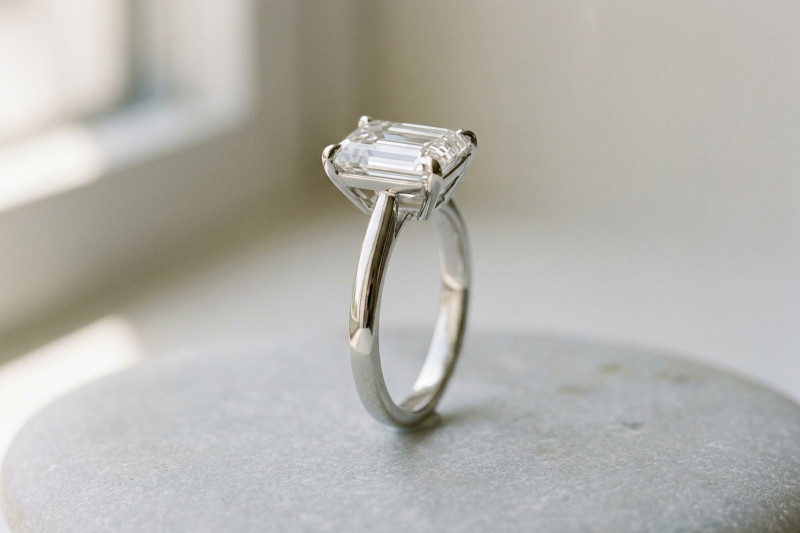
An emerald cut diamond sparkles differently than a round one does. It gives off long, clean flashes of light instead, and that look is exactly why some people won't consider anything else for an engagement ring.
Before you fall for one in a window, it helps to know what the cut shows off, what it gives away, and how the grades on the paperwork translate into what you'll see on your hand.
What makes an emerald cut different
The emerald cut looks like a rectangle. What sets it apart is the way it is faceted. Most popular diamonds are brilliant cuts, covered in small triangular and kite-shaped facets that break light up into sparkle and fire. The emerald cut is a step cut. Its facets are long and flat and run in concentric rows down the stone, like steps.
The GIA describes the result as a "hall of mirrors" effect, with a gleam rather than brilliance. Look into a good emerald cut and you see broad planes of light opening and closing as the stone moves.
The name trips people up. An emerald cut diamond has nothing to do with emeralds, apart from history. According to the GIA, the cut was first developed for emeralds to reduce pressure on the stone during cutting and prevent chipping, and it has since become a popular choice for diamonds.
If you like the outline but want more sparkle, the radiant cut is the one to look at. It shares the rectangle with cropped corners but is faceted as a brilliant, with 70 facets, so it sparkles more and hides inclusions better. The Asscher cut is a square step cut, developed in the early 1900s and popular during the Art Deco period, with a similar gleam to the emerald cut in a more compact shape. We cover the other shapes in our guide to different diamond cuts.
Why clarity matters more with an emerald cut
A brilliant cut's busy pattern of small facets hides small inclusions well, and a lot of buyers rely on that. A step cut has no such cover. With an emerald cut, you're looking straight into the stone through what is close to a window, so anything inside is easier to spot.
The GIA grades clarity on an 11-grade scale. At the top, Flawless means a skilled grader sees no inclusions or blemishes under 10x magnification. Most diamonds sold sit in the middle of the scale, where inclusions are visible under magnification but not to the naked eye.
For emerald cuts, the GIA's advice is to choose VS2 clarity or above, and to go higher again for stones of around two to three carats or more. That advice matters more than it would for a round stone. A grade that would look perfectly clean in a round brilliant can show its flaws in an emerald cut, because there's nowhere for them to hide.
Reading the grading report
One thing surprises people when they compare paperwork. The GIA gives an overall cut grade, from Excellent to Poor, to round brilliant diamonds only. An emerald cut won't have that headline grade on its report. You'll still see a symmetry grade, from Excellent to Poor, along with colour, clarity and carat weight.
That puts more weight on your own eyes. Two emerald cuts with identical grades on paper can look quite different, because so much of their appeal is in how the light moves across the steps. When you're comparing stones, tilt each one slowly under ordinary light and look for broad, even flashes rather than dark, dead areas.
The GIA recommends buying a diamond with a GIA report, which verifies its identity and quality. Ask to see the report and check that the details match the stone in front of you.
How an emerald cut looks on the hand
The long shape is a big part of the appeal. The GIA notes that elongated cuts like the emerald create the illusion of longer, slimmer fingers. The clean lines also suit simple designs. The GIA picks out minimalist, Art Deco and vintage-inspired settings as natural partners.
Emerald cuts also work as centre stones in three-stone rings. If you go that way with diamonds all round, the GIA advises keeping the side stones within about two colour grades of the centre stone. Side stones that are much whiter can make the centre look yellow by comparison.
Choosing a setting
The setting decides how the stone is held, how much light gets in and how well it copes with daily wear. For an emerald cut, two options come up most.
A prong setting, also called a claw setting, uses narrow strips of metal that bend over the edge of the stone. According to the GIA, prongs let the most light in and show off the stone's shape. The trade-off is upkeep. Prongs should be checked from time to time, raised prongs can catch on clothes, and worn tips may eventually need to be rebuilt, which jewellers call re-tipping.
A bezel setting surrounds the stone with a thin rim of metal. The GIA credits bezels with excellent resistance to chips and everyday wear, and the smooth edge is less likely to catch on jumpers or gloves. A bezel lets in slightly less light than prongs, but it gives an emerald cut a crisp, modern outline. It's a practical choice if you work with your hands.
There's more on how each style holds a stone in our guide to common types of ring settings. And if you're already thinking about the band that will sit next to it, read how to choose a wedding ring that matches your engagement ring. A long stone in a raised setting can affect how a straight band sits.
The metal and the hallmark
Whatever setting you choose, check the hallmark on the ring. In Ireland, every article of gold, silver, platinum and palladium has to be assayed and hallmarked, and the Assay Office of Ireland confirms there are no exemptions by weight. The law behind it is the Hallmarking Act 1981, as amended by the Hallmarking (Amendment) Act 2019.
A legal Irish hallmark includes three compulsory marks. The sponsor's mark identifies who is responsible for the piece. Hibernia is the mark of the Dublin Assay Office, which it has applied to every article it hallmarks since 2002. The fineness mark gives the metal content in parts per thousand, so 18 carat gold reads 750 and platinum can read 950. There's more detail in our article on what hallmarking is and why it matters.
Looking after it
Like any diamond, an emerald cut looks dull when it's dirty, and a wash usually brings it back. The GIA suggests warm water, mild soap and a soft brush at home, plus a professional clean now and then. One warning: ultrasonic cleaners can shake loose a stone that is already loose, so have the setting checked before you put a ring in one. If you'd rather leave it to us, see our jewellery cleaning service.
Seeing them side by side
The round brilliant is still the most popular choice, but the emerald cut is one of several shapes in high demand, and it's hard to judge from a photo. The gleam only makes sense when you watch it move, and the difference between a stone that looks clean and one that doesn't is often obvious within seconds.
If you're weighing it up against an oval, a round or a radiant, call into our shop at 5 Mary Street in Dublin city centre and look at the shapes next to each other. You can browse our engagement rings, many of them made in our own Dublin workshop, before you visit.