

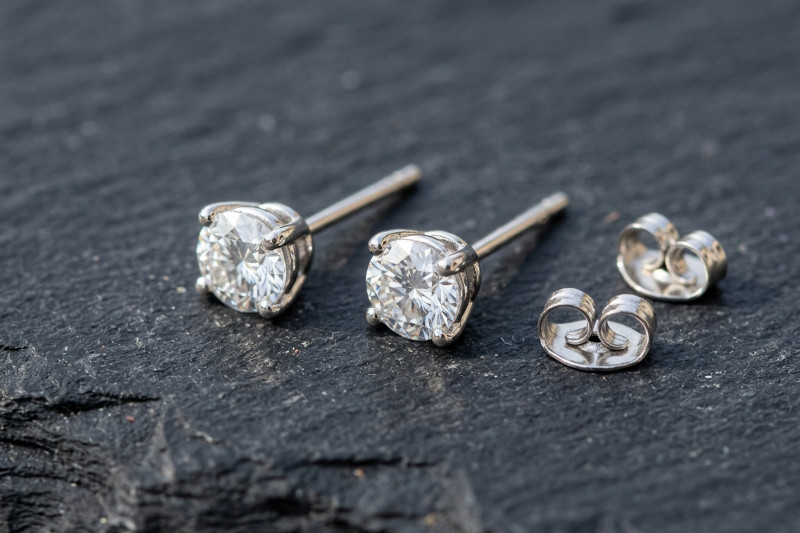
Lab grown diamond earrings are diamonds in every sense that matters when they're on your ears. The GIA describes laboratory-grown diamonds as having the same crystal structure as natural diamonds and the same chemical, optical and physical properties, so by eye the two can be impossible to tell apart.
That makes buying a pair of studs mostly a question of the usual diamond decisions, with a few twists that only apply to earrings. Some of the grades matter less in studs than in a ring, which leaves room to save money without anyone noticing.
What lab grown means
A lab grown diamond is grown in a laboratory rather than mined, but it's also a diamond: tightly bonded carbon atoms in the same crystal structure. According to the GIA, there are two main ways to grow one. High pressure, high temperature, usually shortened to HPHT, recreates some of the conditions deep in the earth inside a press. Chemical vapour deposition, or CVD, grows diamond layer by layer from carbon-rich gas at very low pressure.
Lab grown diamonds are not the same as simulants. Cubic zirconia, moissanite and glass can look similar to a diamond, but the GIA says they are completely unrelated to diamond at the atomic level. If you're weighing those up, our article on moissanite versus lab grown diamonds explains the difference. For the science behind the stones, see are lab grown diamonds real.
Because the two look the same, the paperwork matters. The GIA notes that natural and lab grown diamonds can be told apart in a laboratory using advanced instruments, and its Laboratory-Grown Diamond Report gives colour and clarity details, a plot of the stone's clarity characteristics and whether there's evidence of treatment after growth. GIA also laser-inscribes the girdle of each lab grown diamond it grades with the report number and a statement that it is laboratory-grown.
You're buying two diamonds, not one
This is the part people forget. A pair of studs is two stones, and the GIA's buying advice on diamond studs starts from that point: whatever you'd look for in one diamond, you need twice, and the two have to match each other.
Matching covers all of the 4Cs: colour, clarity, cut and carat weight. Two stones that are each fine on their own can look odd as a pair if one is noticeably whiter or larger than the other. When you're comparing earrings, look at the pair together rather than one stone at a time.
It also helps to be clear about weight. Before you compare prices, make sure you know whether a carat figure refers to one stone or to the pair, because the difference is large.
Where to spend and where to save
Earrings are more forgiving than an engagement ring, because nobody studies them from a few centimetres away. The GIA's advice on studs reflects that.
Colour matters less than you might think. The GIA points out that a diamond's facets act like tiny mirrors, picking up the colour of the metal, your skin, your hair and anything nearby, so paying extra for a completely colourless stone is less important in studs. You can save by going a little lower on the D-to-Z colour scale.
Clarity is another place to save. The GIA says it's unlikely anyone will spot inclusions or blemishes in stud earrings unless they examine your earlobes with a 10x jeweller's loupe. It suggests that the Slightly Included grades, SI1 and SI2, and even the Included grades I1 and I2, can be good value, freeing up budget for the things people do notice.
Cut is where not to cut corners. Sparkle is largely down to cut, and the GIA recommends a brilliant cut for the most sparkle. For round studs, it suggests looking for Excellent or Very Good cut grades. The GIA warns that a poorly cut diamond looks dull and lifeless, whatever its size.
Size is the last lever. The GIA suggests aiming for stones of 0.50 carat or more each if your budget allows, and notes that choosing stones a few points below the round numbers, such as 0.50, 0.75 or 1.00 carat, can save money with little loss of impact. There's more on balancing the grades in our guide to choosing a lab grown diamond.
Choosing the metal
Because diamonds reflect what surrounds them, the metal changes how the stones look. The GIA's guidance is that white metals such as white gold and platinum suit diamonds graded D to J, keeping them looking white. Stones in the M to Z range, which have a noticeable yellowish tint, sit naturally in yellow or rose gold. K and L can go either way, depending on the look you want.
Weight is less of an issue with earrings than with rings. The GIA notes that platinum is denser than gold, so the same setting weighs more in platinum, but in most studs the amount of metal is small enough that you won't feel the difference.
Keeping them clean
Like any jewellery, studs need the odd clean to look their best. If you clean them at home, be careful with ultrasonic cleaners. The GIA warns that they can shake loose a stone that's already loose, so have the settings checked first. Our jewellery cleaning service is there if you'd rather leave it to us.
Ask for the grading report
The GIA's advice is to insist on a grading report for the diamonds in any stud earrings you're considering. With lab grown diamonds, that report is also your written confirmation of what the stones are. Read it, check that the details match the earrings in front of you, and keep it somewhere safe.
If you'd like a jeweller to look over a pair you own, or check a setting or back, call into our shop at 5 Mary Street in Dublin city centre or visit our jewellery repairs page.