

View this post on Instagram
When Selena Gomez announced her engagement to Benny Blanco on Instagram in December 2024, the photos showed a ring with a marquise diamond at its centre. It's a long, slim shape with a point at each end.
Plenty of what's been written about the ring since is guesswork, so this piece separates what she has shown from what other people have estimated. Then it looks at the marquise cut itself: what it is, what to check if you're buying one, and how it's set.
What we know for certain
Gomez shared the engagement news herself, posting photos on Instagram in December 2024 with the caption "forever begins now". The ring was clearly visible in those pictures, and the centre stone is a marquise shape.
The couple married on 27 September 2025 in Santa Barbara County, California. Gomez confirmed it with a set of wedding photos on Instagram, captioned with the date. When the facts in this article were checked on 18 October 2026, we found no announcement of a separation.
There's a nice detail here too. Gomez's 2015 single "Good for You" mentions marquise diamonds in its lyrics, a link the press was quick to point out when the ring appeared.
What has been reported, but not confirmed
Everything else about the ring comes from outside estimates, and the numbers vary a lot. Neither Gomez nor Blanco has given the carat weight, the value or the name of whoever made it.
Jewellers quoted in the press have put the centre stone at anywhere from about four carats to about eight. Grazia reported an estimate of over four carats, while a jeweller quoted by The Zoe Report suggested around eight. Estimates of its value range from about $200,000 to $1 million, depending on the outlet.
Vogue Singapore described the ring as a marquise diamond on a pavé band, meaning small diamonds set close together along it. That is a press description rather than a confirmed specification.
So treat any single figure you see with caution. Estimating carat weight and quality from photos is guesswork, which is why the published numbers are so far apart.
What a marquise cut is
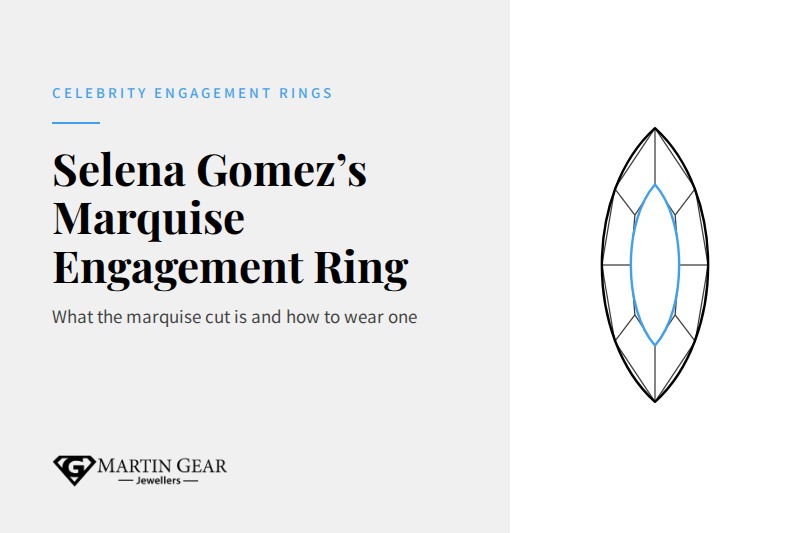
The marquise, also called the navette, is an elongated diamond with two pointed ends. According to the GIA, it is a brilliant cut, so it's faceted for sparkle in the same way as a round or oval diamond, just stretched into a long shape with a point at each end.
The GIA also repeats the story behind the name. Legend has it that Louis XV of France commissioned the shape to resemble the lips of his mistress. It's a good story, and the GIA presents it as a legend rather than established history, so we will too.
Two things make the marquise appealing on the hand. The GIA notes that it often looks larger than other shapes of the same carat weight. Its long outline also makes fingers look longer and slimmer. For a comparison with the other shapes, see our guide to different diamond cuts.
What to check before you buy one
A marquise is less forgiving than a round diamond in some ways and more forgiving in others.
Symmetry comes first. The GIA says symmetry is especially important with a marquise, because uneven sides or points that don't line up are obvious, and they can affect how bright the stone looks. GIA grading reports assess symmetry on a scale from Excellent to Poor, and the GIA suggests looking for Excellent or Very Good. Lay the stone flat and check that both halves mirror each other and that the points sit directly opposite.
Clarity gives you some leeway. According to the GIA, the pointed ends of a marquise can hide small inclusions quite well, so you may not need the very top clarity grades for the stone to look clean.
One thing you won't find on the report is an overall cut grade. The GIA only gives that grade to round brilliant diamonds, so with a marquise your own eyes, and the symmetry grade, do more of the work.
Whatever shape you choose, the GIA recommends buying a diamond that comes with a GIA report or quality assessment. Ask to see it, and check that the measurements and grades match the stone you're looking at. If they don't line up, walk away.
Protecting the points
The pointed tips are the marquise's weak spot. The GIA notes that the length and points make it more likely to chip, so a secure setting matters.
The usual answer is a V-prong, sometimes called a V-shaped claw, at each end. In its guide to ring settings, the GIA explains that V-prongs wrap around vulnerable points and help reduce the risk of chipping. They're used on marquise, pear, heart and princess cuts for that reason.
The GIA's shape guide suggests a few ways to set a marquise. A solitaire, with prongs or V-shaped guards at each end, keeps the attention on the stone's outline. A halo of smaller diamonds adds sparkle and softens the look of the sharp tips. An east-west setting turns the stone sideways across the finger for a more modern look.
A pavé band, like the one described on Gomez's ring, adds sparkle along the shank. The GIA's settings guide says pavé may need occasional maintenance to keep the small stones secure, and that pavé bands can be harder to resize. It's worth knowing before you choose one. Our guide to common ring settings explains how each style holds a stone.
Yellow gold, white gold or platinum
A marquise works in any of the usual metals. A yellow gold band gives a warmer look, while white gold and platinum give a cooler, brighter frame. Whichever you choose, check the hallmark. In Ireland, every gold, silver, platinum and palladium article has to be assayed and hallmarked, and the Assay Office of Ireland confirms there are no exemptions by weight.
If the ring is for everyday wear, think about your hands too. Pointed stones and raised claws can catch on jumpers and gloves. If that's a worry, ask about a bezel, which the GIA says resists chips and is less likely to catch, or a halo around the stone.
Is a marquise right for you?
The marquise suits people who want something distinctive, and it makes the most of every carat. The trade-off is that you need to be choosy about symmetry and careful about protecting the points.
If you're thinking about it, try a marquise on next to a pear and an oval, which are also elongated. The difference is obvious once you see them on your own hand. And if you're already planning the manicure for the photos, we've written about matching your nails to your engagement ring.
We don't sell copies of anyone's ring. If you'd like to see how a marquise looks on your own hand, call into our shop at 5 Mary Street in Dublin city centre and try a few different shapes, or browse our engagement rings first.