

As the old saying goes, “not all that glitters is gold”.
Of course, this is true of most things in life, but for the precious metal itself, sometimes it’s easy to be fooled.
In today’s world, you can easily buy gold jewellery almost anywhere – second-hand, online, or in store – but how do know you’re really getting what you paid for?
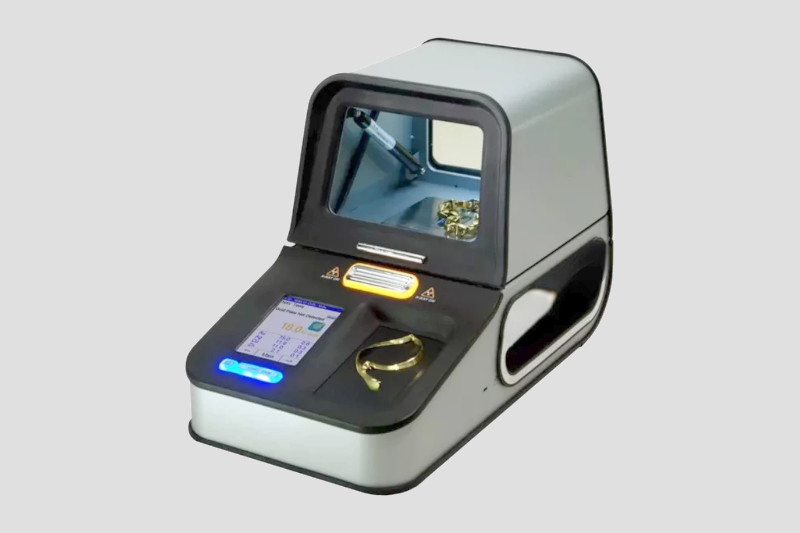
In this post, we take a look how jewellers and ‘Cash for Gold’ (C4G) businesses can use x-ray fluorescence machines to tell ‘fake’ jewellery apart from the real thing.
Firstly, what is an XRF machine?
An x-ray fluorescence machine – otherwise known as an XRF machine – is a non-destructive tool designed to analyse the base elements in a range of precious materials.
For jewellers and C4G businesses in particular, beyond checking any jewellery hallmarks, these machines are vital in identifying true gold and silver jewellery – as well as platinum group metals like palladium and platinum – from any possible “fakes”.
How do XRF machines work?
XRF machines work on the science of ‘x-ray fluorescence’.
In simple terms, this process involves firing a targeted beam of radiation (in this case, x-ray radiation) at a jewellery sample. In turn, this causes the jewellery’s metal to then give off invisible light waves – or fluorescent x-rays – that are then detected and read by the XRF machine.
To give some better insight, the individual light waves, or fluorescent x-rays, given off by the sample are probably best described as a ‘unique fingerprint’ – this is because each element in nature gives off its own one-of-a-kind light wave.
At the end of the test, the XRF machine then gives a comprehensive report of the jewellery sample’s chemical composition – or the list of ‘substances’ used to make up the piece. This is how businesses then measure the purity of any precious metal in your jewellery.
Can XRF Machines damage jewellery?
XRF testing is a type of non-destructive analysis – this means that the testing process does not damage or affect the value of your jewellery in any way.
Using this method, jewellers and C4G businesses can guarantee an extremely quick and accurate reading, usually in just 5 - 120 seconds (with the length of time usually dependent on the type of jewellery).
The results of this XRF test then allow them to easily detect any non-standard metals, under-karated gold, or examples of counterfeit jewellery – factors that are usually difficult to determine with other standard methods such as acid testing.
How reliable are XRF machines?
XRF machines are extremely accurate.
As a technology that’s been around for over 70 years, XRF machines has proven themselves to be a very reliable technique for the analysis and identification of materials of all types.
These machines can easily measure precious metals like gold, silver, platinum and palladium, as well as more common elements such as nickel, copper, iron, to an accuracy level of around 0.01%!
Looking to test OR sell your precious jewellery?
At Martin Gear Jewellers, we can easily get any type of jewellery tested in order to determine its purity. Our various partners, and the Irish Essay Office, have access to XRF machines for precious metal testing.
As well as that, with our ‘Cash for Gold’ service, we also buy all types of gold, palladium, platinum, white gold, and rose gold jewellery – regardless of the amount or condition it’s in – providing some of Dublin’s best prices per gram.
For more information, give us a call on (01) 872 8726, drop into our store in Dublin City Centre or take a look at our dedicated Cash for Gold page.